Alpine wines; Vallée d’Aoste
Nestled between the Valais and Savoie, the Vallée d’Aoste is a tiny, bilingual Alpine wine region. Its terraced vineyards and rare local grape varieties produce wines that are notable for their bright acidity and pronounced mineral salinity.
There are some continuities between these three regions: shared grapes, Alpine geology, and a Franco Swiss cultural thread. Even the language is the same.
The Vallée d’Aoste is a bilingual autonomous region at the extreme northwestern part of Italy, at the South of the Mont Blanc massif, with the Savoie to the west and the Valais in the north.
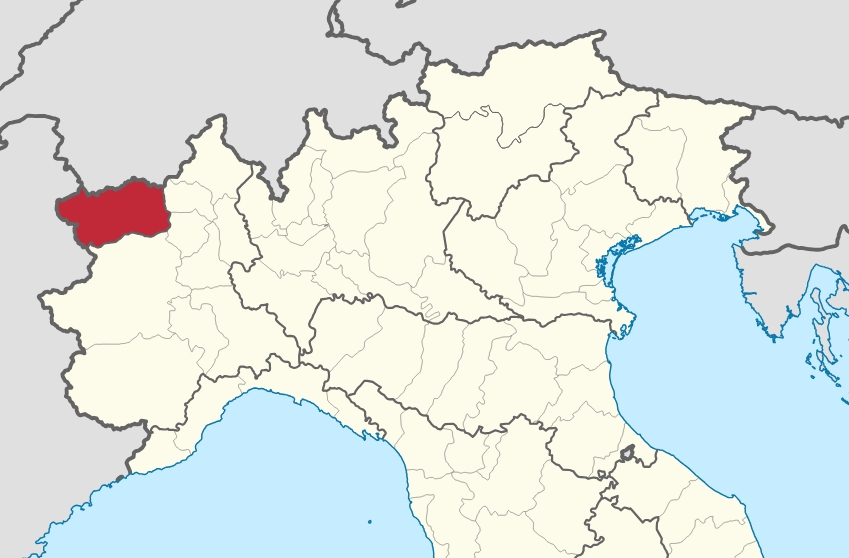
Aoste is well known for its luxury ski resorts, like Courmayeur, and its cheeses, like the Fontina, but is less known for its wines.
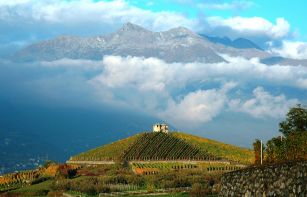
The Vallée d’Aoste DOC vineyard, with about 500 hectares, is one of the smallest vineyards in Italy.
A Long History
The Aoste region was inhabited by a Celto-Ligurian population, the Salasses since the Bronze Age. The region was conquered by Rome in 25 BC and became an important military and commercial crossroads.
After the fall of the Roman Empire, the valley passed into the hands of the Duchy of Savoy (which wasn’t part of France at this time). In 1561, French became the official language of the Duchess, and therefore in the valley.
In 1861, the valley was integrated into the Kingdom of Italy, shortly after the Savoie integration into France.
At the end of the Second World War, a project to annex the Aosta Valley to France was abandoned. In 1945, the Aosta Valley obtained autonomous status, and bilingualism (French and Italian) became official, the “Région Autonome Vallée d’Aoste”. Wine production dates back to the 5th century BC, making the region one of the oldest wine regions in western Europe.
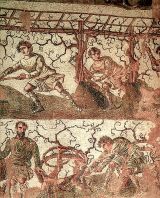
During the Roman era, the vineyard flourished. Amphora from the region were found in many places in the Empire.
During the 17th century, Families from Burgundy and Savoy settled in the region after the great plague of 1630. They brought with them expertise and their tradition, and some grape varieties from beyond the Alps, like Pinot Noir and Gamay.
Just before the phylloxera crisis, the vineyard grew up to 2000 hectares. After the vineyard declined until the end of the Second World War, there was a renewal of the Valley’s identity.
Climate and soil
The vineyard is concentrated on the Dora Balte River, in the mountains between 300 and 1200m high. The vineyard is largely cultivated on terraces on the hillsides and on pergolas. Just like in Valais and Savoy, there are several microclimates.
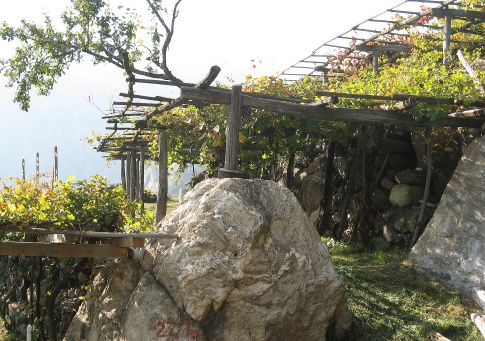
Because of the high elevation, some areas were never affected by the phylloxera louse and still use non-grafted roots.
The terroir combines limestone soils, alluvial sediments, and clays depending on the area. The climate varies from cool mountains to semi-continental with short, hot, and dry summers.
Grappe Varieties
The grape varieties used in the vineyard are distinct from those of neighboring Italian regions and are adapted to the terroir. It is a blend of local grape varieties, coming from Valais, France, or Piedmont.
red/black varieties
- Petit Rouge (a local rustic grape variety, derived from the Cornalin grape variety)
- Gamay (French migrant variety)
- Pinot Noir (another French variety)
- Cornalin (Present in Valais and in Aoste)
- Fumin (Local Variety, tanic and acid)
- Mayolet (Local variety, give light wine often used with Petit Rouge)
- Nebiolo (From Piemont)
- Premeta (Local Variety also called Bonda)
- Vien de Nus (Local variety almost extinct a decade ago)
white varieties
- Chardonnay
- Muller-Thurgau
- Petite Arvine (Variety from the Valais, gives complex wines with a fruity and salty touch)
- Pinot Blanc
- Malvoisie (a clone of pinot gris)
- Prié Blanc (local variety also known as Blanc de Morgex, floral and mineral)
Appellations
Despite its small size, the Aoste vineyard has several appellations in the Italian appellation system. The DOC (Denominazione di Origine Controllata) was established in the mid-80s. There are several sub-regions in the appellation.
- Blanc de Morgex et de La Salle, only white wine using Prie Blanc. The cultivation of the vines takes place along pergolas at altitudes between 900 and 1200 m.
- Enfer d’Arvier, a floral red wine with Petit Rouge (at least 85%) and Vien de Nus, Neyret, Pinot Noir, Gamay, or Dolcetto.
- Donnas, red wine made with Nebbiolo or Neyret with Freisa.
- Torrette, Red wine made with Petit Rouge (at least 70%) and Gamay, Fumin, Pinot Noir, Vien de Nu, Mayollet, or Premetta.
- Nus. Red wine is made with Vien de Nus (at least 70%), with Petit Rouge and Pinot Noir. White wine is made with Malvoisie (the local variation of Pinot Gris).
- Chambave. Red wine made with Petit rouge (70%) is often associated with Gamay, Pinot Noir, or Dolcetto. White wine only with Muscat à petit grain.
- Arnad-Montjovet, only red wine using Nebbiolo, Dolcetto, Pinot Noir, or Vien de Nus
There are also generic appellations, Aoste Rouge, Aoste Rosé, Aoste Blanc, and even a primeur wine, Aoste Nouveau.
Finding wine from Aoste is difficult, but not impossible.
One producer that comes to my mind is the Domaine de Petits Riens, a Franco-Italian couple in Aoste, 2 Hectares at 600 meters with 12 varieties.
They mostly produce red wine and some white wine, mostly with Petit Rouge. One example is Cuvée Si, a 100% petit rouge, short maceration, and 18 months aging.
The domaine Maison Maurice Crétaz. Established in 2014, the wine uses local grapes Petite Arvine and Prié Blanc for white wine, and Petit Rouge, Cornalin, Mayollet, and Nebbiolo for the red.
If you’re looking for wine from the region, look for Petit Rouge for a savory, herb tinged red and Prié blanc for a floral, saline white that speaks of high vineyards. You can also try an Aoste Gamay, to make the comparison with Beaujolais, or a Pinot Noir to see the difference with Savoy and Burgundy.