Chardonnay, The attack of the clones
You think you don’t like Chardonnay? You might be wrong; you just don’t like clone 76. That one vine, selected decades ago for productivity over flavour, was copy-pasted into vineyards across the globe and came to define what generations of wine drinkers wrongly think Chardonnay tastes like, but it’s just a pale copy, the equivalent of an influencer compared to Cervantes.
Here’s the thing: for thousands of years, vignerons did everything they could to stop their vines from having sex, anything to avoid the genetic lottery of a seed. Then, in the 1960s, science gave them the ultimate copy-paste tool: certified clones. This is the attack of the clones Chardonnay edition.
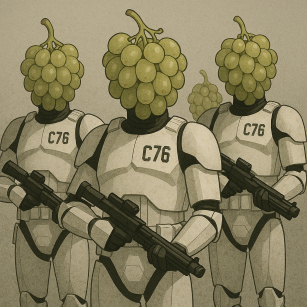
Grapevines reproduce like most living things: through sex. Pollen from one plant meets the flower of another, DNA gets shuffled, and the resulting seed is a brand-new individual; genetically unique, completely unpredictable. The nature’s lottery ticket
Take a Chardonnay vine. The grapes it produces are Chardonnay fruit; they come from the plant itself. But the seeds inside those grapes are a different story. Each seed carries DNA from two parents, and just like you and your siblings. Plant a Chardonnay seed, and what grows will not be Chardonnay. It’ll be something new, something unknown, a roll of the genetic dice.
Sometimes, the dice rolled well. from the cross between Pinot Noir and Gouais Blanc we had two varieties that couldn’t be more different, Chardonnay and Gamay. It’s the same for other varietied; Cabernet Franc and Sauvignon Blanc had an unplanned encounter that gave the world Cabernet Sauvignon. Cabernet Franc with Magdeleine Noire des Charentes and hop Merlot. Every great variety we know started as an accident.
But for every Gamay that made it, hundreds of unnamed seedlings were ripped out and forgotten. Most crosses produce mediocre fruit, strange growth patterns, or vines that simply can’t survive. The success stories are the exceptions, the vast majority of nature’s experiments end up as firewood.
Ancient vignerons understood this perfectly. They had no interest in gambling with their livelihood. As far back as the first century AD, Columella laid out precise instructions in De Re Rustica for multiplying vines vegetatively, not through seeds, but through cuttings and layering. Take a cane from your best vine, bury it in the soil, let it root: you get an exact genetic copy. No surprises, no lottery. Just a reliable twin of the plant you already know and trust.
This technique, provinage, was the standard for centuries. In each vineyard, growers would select their most promising vines and propagate them. But here’s what makes it beautiful: over generations, tiny natural mutations accumulated. No two vines were perfectly identical anymore. Each vineyard became a living population, a genetic fingerprint shaped by its soil, its climate, and the choices of the people who tended it. That slow, organic diversity was part of what we now call terroir, and most people had no idea it was there.
Then phylloxera hit. Starting in the 1860s, this tiny root-feeding aphid devastated European vineyards. The only solution: graft European vines onto resistant American rootstock. The mass replanting that followed wiped out much of the subtle intra-varietal diversity that had accumulated over centuries. Some fragile varieties disappeared entirely, unable to adapt to the new grafted reality. It was the first great standardization.
By the mid-twentieth century, European vineyards faced a different enemy: viruses. Fanleaf virus twisted leaves and stunted growth. Leafroll virus prevented grapes from ripening evenly, producing unbalanced, dilute wines. Some estimates suggest that by the 1950s, a majority of French vines carried at least one viral infection. Yields were unpredictable, quality was suffering, and growers needed a solution.
In 1962, France’s agronomic institutes delivered one: certified clonal selection. The process was rigorous, identify a single healthy vine, screen it for every known virus, test its agronomic performance over years, then multiply it and distribute it through nurseries. Each approved clone received a number, Clone 76, Clone 95, Clone 548. Romance was not the priority. Survival was.
It’s easy to look back from 2026 and dismiss the clone era. But in the 1960s, planting a certified clone meant the difference between a viable harvest and financial ruin. Virus-free vines ensured steady yields, consistent quality, and sustainable income from your land. For a generation of growers who had watched their vineyards slowly decline, clones were a good compromise.
Dozens of Chardonnay clones were eventually approved, each with slightly different characteristics. But not all clones are created equal, and market dynamics have a way of picking winners. Remember clone 76 from the first line of this article? Here’s its origin story.
The Clone 76 was selected in Burgundy in the 1970s, and on paper, it looked like a winner. Reliable fruit set, good adaptability across climates, consistent yields. Nurseries loved it because it was easy to propagate. Growers loved it because it delivered every year. But its strengths were economic, not qualitative and that distinction would come back to haunt an entire variety.
The 70s is also the beginning of industrial wine.The public started to buy wine in supermarkets instead of wine caves. Cheap wines were available in bars and restaurants. To feed this market, the Clone 76 was planted almost everywhere in France and other countries, making the Clone 76 the standard for all Chardonnay across the world.
What clone 76 lacks is inspiration. It produces clean, technically correct wine, the kind that passes every lab analysis without raising an eyebrow. But it’s bland. No tension, no texture, no terroir expression. A Chardonnay from clone 76 grown in Burgundy tastes remarkably similar to a clone 76 grown in Australia or Chile. It has consistency across regions, which makes it the ideal clone for supermarket shelves, and the worst possible ambassador for a grape variety capable of producing incredible wine. That’s why you think you don’t like Chardonnay. You just haven’t met the right one yet.
While clone 76 was conquering the world’s nursery catalogs, not everyone followed. In Burgundy’s Côte de Beaune, in Chablis and Maconnais and in parts of the Jura,and many places where terroir identity was non-negotiable, many domaines never ripped out their old vines. They didn’t need a catalog. They had their own vineyards, some planted decades earlier. They clone their own plant with modern tooling. This is process is called massal selection.
The difference in the glass is unmistakable. Wines from massal selections or old pre- clone area, tend to have smaller berries, more concentrated juice, and a complexity that’s hard to describe but impossible to miss, a sense of depth, of layers unfolding, of a wine that tastes like somewhere rather than like something. Side by side with a clone 76 Chardonnay, it’s not a subtle distinction. It’s not even the same wine.
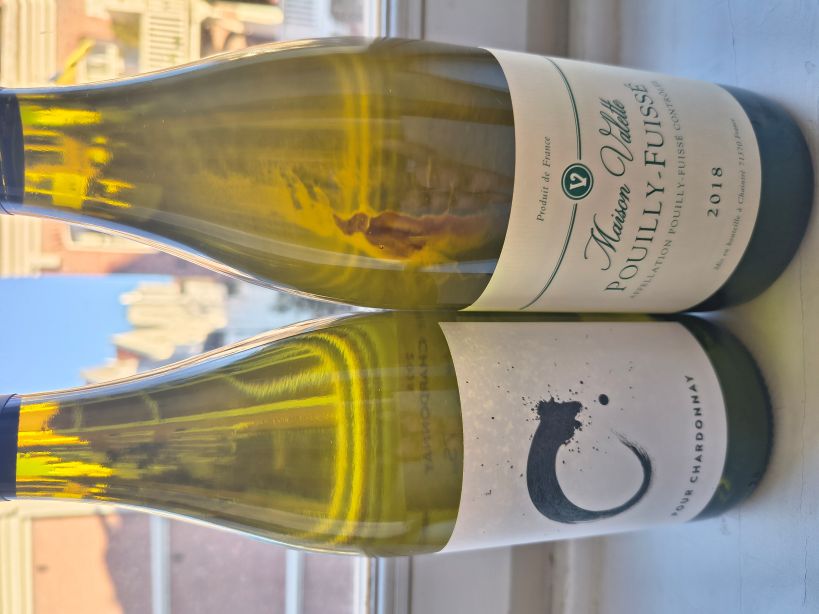
Today, a growing number of producers, particularly in the natural wine mouvement and fine wine worlds — are actively choosing massal selection over clonal planting. Many Domaines have maintained their own selections for decades. The logic is simple: if you want your wine to express a place, the vines themselves need to carry that place’s genetic memory.
Massal selection isn’t without risks. If the old vines you’re selecting from carry viruses, you propagate the infection along with the genetics. Sanitary screening is non-negotiable. Some growers take a hybrid approach: planting five or six different certified clones for a healthy genetic base, then layering in massal selections from their oldest, most trusted parcels. Dogma helps no one. Intelligence does.
Clone 76 was created to save an industry, and it did. But somewhere along the way, it stopped being a tool and became the default, filling supermarket shelves and quietly redefining what an entire generation believes Chardonnay tastes like. The truth is, a variety cannot be reduced to a single clone. Genetic diversity isn’t a flaw to be engineered away. It’s an ingredient of terroir, as essential as soil, slope, and climate.
So the next time someone tells you they love Chablis but don’t like Chardonnay, don’t argue. They’re right, it is often not the same wine.