The Postman Always Sips Twice: who gets to define natural wine?
Sometimes it is better to open a bottle than an email. Some winemakers may have thought exactly that in December 2023, when Sylvie Augereau, who has organised La Dive Bouteille since 2002, wrote to the vignerons invited to the salon. Most of the message was practical. The last lines were not:
« Merci encore de garder vos cuvées un peu trop barrées à la maison, pour ceux qui croient que les vins vivants c’est forcément déviants… On est vraiment pas là pour alimenter ce discours dangereux. Il y a des intrants qu’on préfère à certains intrus ! »
Thanks again for keeping your weirdest cuvées at home, for the sake of those who think living wines are necessarily deviant. We are not here to feed that dangerous narrative. There are additives we prefer to certain intruders.
That last sentence is a pun (the French love pun); intrants (additives) and intrus (intruders) sound the same in French. This is the sentence that caused the storm in the natural wine world. it says: a little sulphur is more welcome here than some of you. In one line, the organiser of the best-known natural wine salon in France had named a split the movement usually keeps quiet about: between winemakers who add nothing at all with the risky of having a fault, and the larger group who allow themselves a little sulphur at bottling.
The reputation she was pushing back against is not new. From the 2010s, some natural wines smelled of the farmyard, turned volatile or oxidised, or went mousy. They were never the majority, but these are the wines people remembered. For the public these faults became the mark of natural wine.
In Déviant : le vin nature par défaut(s), Olivier Grosjean looks at these faults, old and new. The title plays on par défaut (by default) and défauts (faults). His argument is that deviance is as old as wine itself. He just invites us to accept this “faults” within our perception. What matters, in the end, is whether you like what is in your glass.
Today there is a new trend. A group of bars, wine shops, restaurants and winemakers has turned these faults into a revendication. They call it déviant, sometimes funky; some name their establishments after it, or after vola, short for volatility. And here is the shift that matters. Before, deviance is a question of perception: you like it or you don’t. For them, it has changed to an obligation.
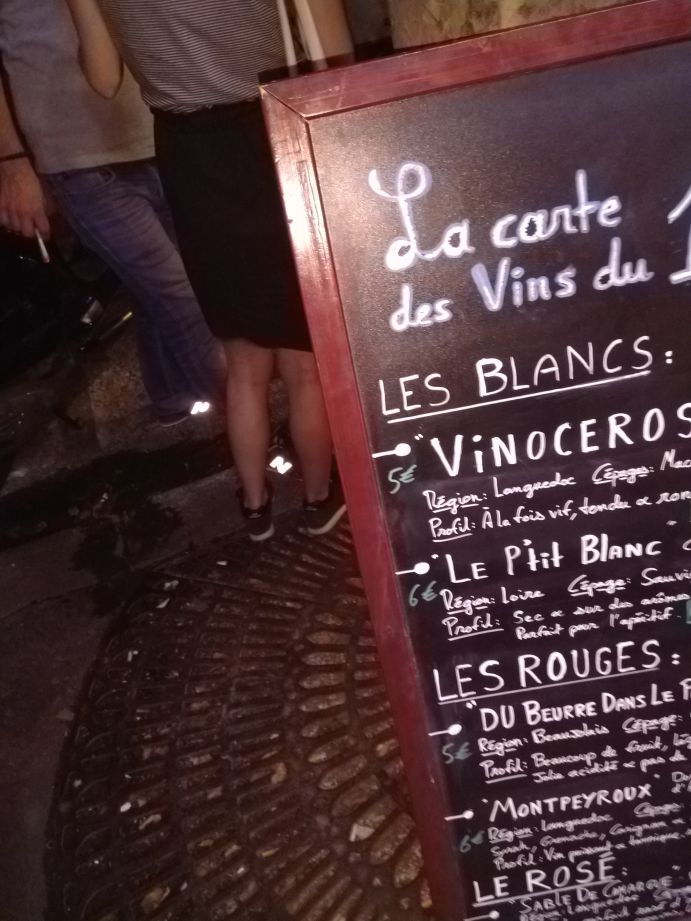
Many of these places have no wine list and no chalkboard. The waiter tells you what open tonight is, and next week it will be something else. It is nice or strange, but you rarely know who made the wine, or how. For a movement that began by asking what was in the bottle, that is an odd turn, and it pushes natural wine towards caricature.
In this view, a clean natural wine is suspect: if nothing is wrong with it, someone must have added sulphur. Zero is the motto, whatever the cost. Better a failed wine than a few milligrams of SO₂ at bottling, or any change in the cellar. The method has become the goal, and the only measure of naturalness.
Wine always contains sulphite, added or not. It is a byproduct of the yeast activity. Unless you are one of the small number of people who are sensitive to them, most of them asthmatic, they are not a health issue. It doesn’t give you more headache. The only point is, with more than 30 mg per litter, some tasters will find the wine dryer and harder than with less sulphite.
There is something amusing about wine considered faulty. Natural wine pionners, often have too, discard their wine because of a faulty. Generally, they send it to distillation. And this were we have one of the rarest Dutch words in the French wine vocalubary, BrandWijn (Brandevinin French). In the 17th century, Dutch merchants bought French wine and distilled it so it would survive the journey to a bar in Amsterdam or Rotterdam. That is now the destiny of wine considered to bad for consumption.
Natural wine pioneers like as Marcel Lapierre did it, and many natural winemakers still do. Rather than sell a wine they aren’t proud of, they let it become something else, usually ethanol for the industry.
Sometimes the still leads somewhere better. In 2018, Patrick Bouju had a cuvée that went wrong. Instead of sending it off as ethanol, he turned it into Gentiane, a bitter gentian aperitif you can still find today.
The founders wanted clean wine. In Beaujolais, in the Jura and elsewhere, they weren’t setting out to make “natural wine”, the label will come later. If something gets wrong, discard the wine. In the Beaujolais, in the Jura and elsewhere, the idea was to make a wine pure to express the terroir, the sense of place. The founders never try to sell failure as complexity.
Jules Chauvet, the Beaujolais chemist and négociant who inspired Lapierre and his friends to work without sulphur, insisted on healthy grapes, cold, and a clean cellar. The man behind sulphur-free winemaking was, above all, a stickler for cleanliness. And today, many winemakers follow this path. Avoiding deviance and funkiness and focus on the one question that matters: is the wine good? Whether it comes from a single plot or an eccentric blend, it must taste good.
Not all faults are equal, though. Some of the most admired wines in the world are built on what would be called a fault, oxidation. Madeira is heated and aged in contact with air. Rivesaltes and Maury tuilé are left to age in barrels, or in a dame Jeanne out in the sun. The Jura takes another route: Vin Jaune ages for years under a voile, a thin film of living yeast that forms on the surface of the wine. Sherry does both, depending on the style. Different methods, similar results: nuts, dried fruit, spice.
The style doesn’t need to follow a tradition. Domaine Sauvetère use oxidation in its chardonnay to express their full potential.
It is paradoxal, when a wine oxidises by accident, we call it maderised from the name Madeira, a prised fortified wine.
Volatile acidity is the same story. Controlled, it gives a wine lift and character; uncontrolled, it smells of vinegar. The culprit is mostly acetic acid, and two kinds of bacteria produce it. One lives on the grapes and feeds on sugar, which is why some sweet wines, whose grapes started to break down before harvest, carry more volatility. The other lives in the cellar and turns alcohol into vinegar. Yeasts can add to it too, especially in very sugary musts.
Under some conditions, acetic acid can also be degraded into ethyl acetate by rogue yeast (Hanseniaspora), by acetic bacteria and simple degradation of the acetic acid. This gives the smell of nail polish remover.
Here, everything is a question of balance, give some volatility, fruitiness and the perfect amount of alcohol, it is perfect, more acidity, it is a fault.
There are also two other common faults in Natural wine, The Brett, that give the barn and the farm smell, and the mousiness. But you can referee to these two articles https://blog.boire-et-manger.nl/wines/brett/ and https://blog.boire-et-manger.nl/wines/mousiness/ for more detail.
In the end, it all comes down to the dose, and to balance. Paracelsus put it best: sola dosis facit venenum, the dose makes the poison. Some volatility, balanced by fruity flavor and the right level of alcohol, can make a great wine. In a red, a touch of brett with elegant tannins can add some complexity.
Perception matters as much as the dose. Mousiness is the clearest case: a large proportion of people can’t detect it, while others pick it up at tiny levels, usually just after swallowing. We aren’t built the same, and we don’t taste the same. Some will enjoy a little deviance, others won’t. But almost everyone recognises a good, clean wine.
So, faultiness proves nothing, and certainly not that a wine is natural. What, then, does a clean natural wine prove? A set of practices.
For the déviants, as we saw, a clean natural wine is suspicious: it must be hiding some sulphur. But cleanliness starts long before the cellar. It starts at harvest, with healthy bunches, damaged ones sorted out, and grapes brought in cool. It continues in the cellar, where hygiene keeps unwanted yeasts and bacteria away. Cold, time and care are tools, not additives. Chauvet understood this decades ago. Sometimes a small dose of sulphur at bottling is still needed. Often it isn’t.
A clean zero-sulphur wine is not a sign that someone cheated. It is the reward of hard work in the vineyard and the cellar. Faults are not all inevitable. And no fault, however much some people enjoy it, should get to define an entire movement.
We saw this story with Bordeaux wine, where the mark of a Bordeaux, was a fully woody wine. It doesn’t matter if the wine is good as long as it’s oaky. Is brett the new oak? And are drinkers ready for that?
Some clearly think so. In Paris, a handful of bars now pour almost nothing but bretty or volatile wines. But I’ve also seen the backlash. Natural wine is once again seen as strange, the stuff with a bad smell. Some restaurants have dropped the word nature next to their best natural wines. And regulars are drifting away from bars where a bottle has the half-life of a raspberry in full sun, towards places pouring more classic natural wine.
There’s an amusing geography to all this. Tell me where you drink in Paris, and I’ll tell you what kind of natural wine is in your glass. A hint: the neighbourhood places, away from the centre, tend to pour the cleanest wine and they have a writing menu.
Some winemakers have adjusted too, tightening their work in the vineyard and cellar and adding a little sulphur to their best cuvées when a vintage calls for it. This the case for Mark Angeli, at La Ferme de la Sansonnière, with his Chenin Blanc.
In Amsterdam, the picture is different. You can find off-the-wall bottles if you look, and there are exceptions, but they aren’t what the city’s natural wine bars are known for. The déviant style that took hold in Paris and elsewhere either never reached Amsterdam at the same level or didn’t stay long enough for me.
The problem is not a matter of taste. Everyone has the right to like or dislike a style of wine; that’s a preference, not a principle. There will always be drinkers for oxidative, bretty or very volatile wines. It’s a small public, and I’m not part of it. If someone offers me a choice between a bretty natural wine and its industrial counterpart, I’ll drink a beer But who decide if a wine is natural or not? The Raisin app, the reference application for Natural wine, uses the rule from the “L’Association des Vins Naturels” 30 mg/L of SO2 for reds, 40 for whites as one of the seven criteria to determine if a wine is natural or not (see ).
The revue “le Rouge et le Blanc”, another reference for natural wine, say that natural wine should not add SO2 during or before the fermentation, but some is permitted during the bottling. Among other process.
In other words, the people who have actually tried to define natural wine look at the whole process. Arguing for zero sulphur is fair enough. Refusing the word “natural” to a wine that received a few milligrams at bottling only adds confusion.
There is no legal definition of natural wine in France, and you can’t put vin naturel on a label. The one exception is a small irony: vins doux naturels, like the Rivesaltes and Maury we met earlier. They are made by adding grape spirit to stop fermentation. The only French wines allowed to call themselves naturel have had brandy poured into them.
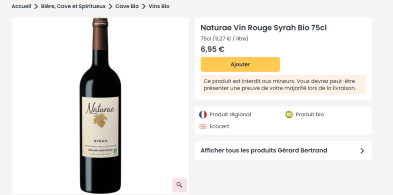
At the same time, the industry has noticed the trend around natural wine. Making wine without sulphur isn’t hard if you’re willing to use heavy tools: sterile filtration, heat treatment, other additives in sulphur’s place. Supermarket shelves already carry bottles with names like Naturae, Naturellement or Réserve Naturelle, borrowing the vocabulary of natural wine for something that has little to do with it. A definition built on a single number is the easiest kind to game.
We need a real definition of natural wine, not a slogan or an anathema. “No sulphur” is easy to explain and easy to remember. But it gives no credit for the work natural winemakers do in the vineyard and the cellar, and it opens the door to anyone who can make wine without SO₂, by whatever means.
And the timing is bad. Wine consumption in France is falling, down 3.6% between 2023 and 2024. There are no reliable figures for natural wine, but it is unlikely to be immune. A category that asks newcomers to accept a strange smell as proof of honesty is not well placed to win them over.
A definition already exists. Since 2020, the Syndicat de défense des vins nature has run a charter called Vin Méthode Nature, approved in France by the fraud-control authority, the DGCCRF. Certified organic grapes, picked by hand. Native yeasts. No additives, no fining or filtration, none of the heavy processing , no reverse osmosis, no flash pasteurisation, no thermovinification. No sulphur before or during fermentation. Internal checks and random external audits.
It offers two logos: one for wines with no added sulphur, one for wines with a small adjustment at bottling, under 30 mg/L. Read that with the La Dive email in mind. The zero-zero winemaker has a label. The winemaker who adds a few milligrams at bottling has one too.
So the quarrel that started in Sylvie Augereau’s inbox in December 2023 had an answer waiting since 2020, at least on sulphur. Each side preferred defending its slogan to pointing at a set of rules that already had room for the two side.
As for the intruders, they were never the winemakers with a few milligrams of sulphur. They are on the supermarket shelf, with Naturellement on the label.